
The Almond Project
Advancing Soil Health for California Agriculture
Our Mission
The Almond Project is a multi-year, farmer-led partnership created to identify more sustainable farming methods and pave the way towards a more resilient future for almonds. By building a coalition of farmers, scientists, brands, technical service providers, processors, and customers, we’re implementing and testing a variety of soil health practices on almond farms in California. We’re measuring key outcomes across soil and ecosystem health, such as water holding capacity and infiltration, carbon sequestration, and ecosystem biodiversity in comparison to neighboring baselines. Our mission is to preserve natural resources, enable ecosystem regeneration, protect farming communities, and ensure the livelihood of nutritionally-rich almonds for generations to come.
Soil Health Practices
These practices aim to improve natural soil biology and fertility, sequester carbon, conserve water, and increase biodiversity.

Multi-Species Cover Crops
Cover crops can help prevent erosion, increase soil organic matter (SOM), improve soil structure, create habitat for beneficial microorganisms, and enhance water infiltration.

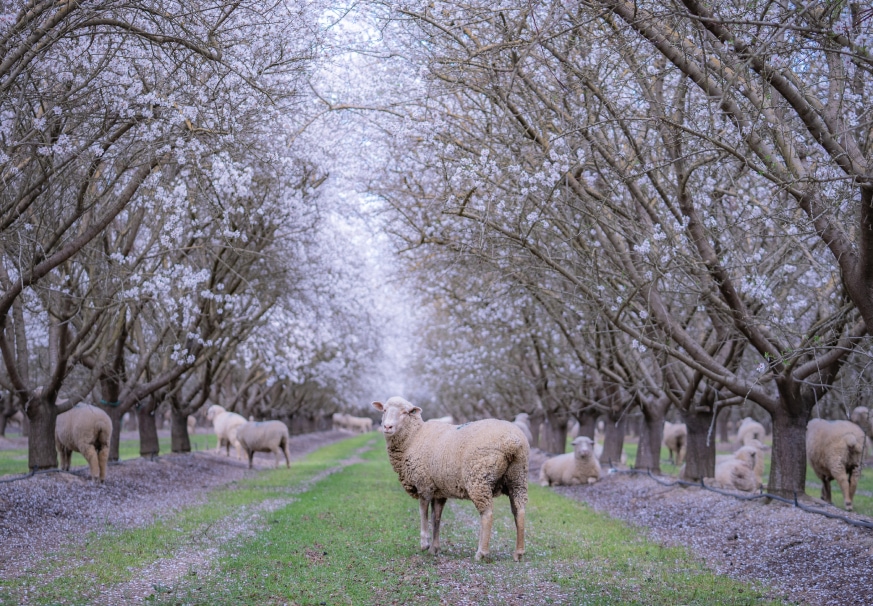
Animal Integration
Intentional inclusion of animals in cropping systems such as orchards can improve soil biology and fertility, increase biodiversity, and help manage cover crop and weed growth through grazing.

Increased Compost Application
Compost application has been shown to increase soil organic matter (SOM), microbial activity in the soil, and moisture retention. It can also allow for reduced inputs.

Input Reduction
Soil health-focused management principles in combination with the reduction of inputs such as synthetic pesticides, herbicides, and fertilizers can build ecosystem health and improve farm economics.

Soil & Ecosystem
Health Testing
Monitoring outcomes such as soil health, water infiltration, carbon sequestration, ecosystem biodiversity, and farm-level economics in comparison to baselines.
The Why

Almonds are a nutrient-dense, protein-packed superfood. But the climate crisis poses a dire threat to these nuts and the farmers whose livelihoods depend on them – especially in California, which supplies 80% of the world’s almonds.
We believe that healthy soil is key to the longevity of almond farming – but practical research is hard to come by, and the financial risk of testing and adopting new practices too often falls solely on farmers. Food companies have a responsibility to share the economic burden.
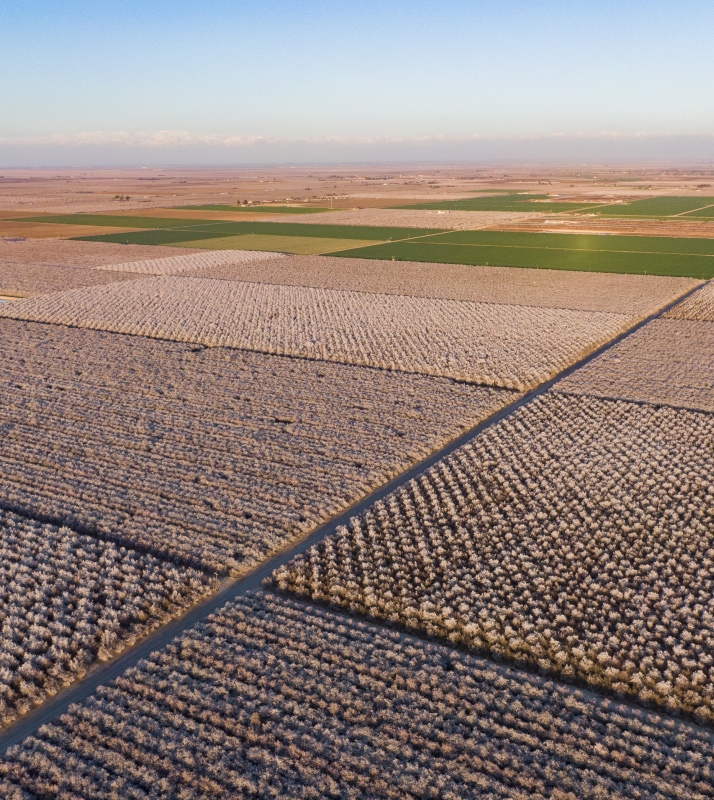
In the short term, The Almond Project aims to identify approaches to almond farming that improve soil health, increase biodiversity, and empower local farming communities. Longer-term, the program seeks to develop proof points to incentivize farmers and food companies to adopt practices that have the potential to regenerate California’s working lands, contribute to balancing our climate crisis, and enable the sustainability of farming in the Central Valley for generations to come.
The Founding Partners
We are a rare coalition of cross-functional advocates – farmers, scientists, brands, technical services providers, processors, and customers – working together to evolve the health of our food system.

Revolutionizing food design for people & our planet
Learn more
Delicious food built on real, unrefined fruits + vegetables that is good for you and the planet.
Learn more
Setting a new standard for frozen food.
Learn more
We grow it. We slice it. We dice it. From our family to yours.
Learn more
Restoring Our Ecosystem through Agriculture
Learn more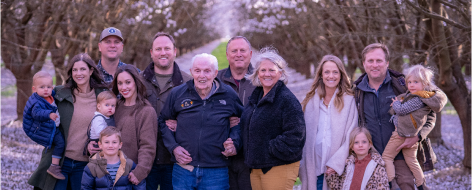
New Partners
At GoodSAM, we make snacks that are good for you, good for farmers, and good for the planet.
Learn more
Daily Crunch makes uniquely crunchy™ sprouted nut snacks made with minimal and clean ingredients, free from seed oils.
Learn more
Pip & Nut is the UK’s number one natural nut butter brand. Founded in 2015 by CEO Pip Murray - The Grocer’s 2024 Entrepreneur of the Year - Pip & Nut’s peanut and almond butter have become household shelf-staples. How? It’s simple. They let the nuts do the talking.
Learn more
We make Sunday-inspired breakfast that brings people together, made with the very best ingredients. Founded in 2011 with a bike and a stall at the local farmers market, Hannah had the crazy desire to flip the breakfast aisle on its head. Seven Sundays is a proud woman-founded, family-run, B Corp breakfast company sold nationwide.
Learn more
Since 1978, Bob’s Red Mill has brought simple, authentic ingredients to your table. As a 100% employee-owned company, everything we do reflects the care, accountability and pride of our employee-owners, from the ingredients we source to the food we share.
Learn morePrevious Partners

We believe in GOOD: The Good in Us. The Good Life. Doing Good.
Learn more
At Justin’s, we’re crafting delicious, real food products made with high-quality, mindfully-sourced ingredients that contribute to our world in a positive and meaningful way.
Learn moreOur Support Team
Geordy Wise
Senior Vice President Farming Operations, Pacific Ag Management
Cary Crum
Technical Assistance Partner, Agri Technovation
Dr. Jessica Chiartas
Soil Scientist, Soil Life Services
Lauren Tucker
Project Coordinator, White Buffalo Land Trust
Geordy Wise
Senior Vice President Farming Operations, Pacific Ag Management
Cary Crum
Technical Assistance Partner, Agri Technovation
Dr. Jessica Chiartas
Soil Scientist, Soil Life Services
Lauren Tucker
Project Coordinator, White Buffalo Land Trust
Our Work
Learn about our research and current projects below.
Five Year Soil Health Study Fall 2021-2026
The Almond Project’s Five Year Soil Health Study is a commercial-scale research initiative running from Fall 2021 through 2026, designed to generate rigorous, real-farm data on the impact of regenerative soil health practices in California almond production.
Study Design
- 160 acres of active soil health management blocks (80 acres organic / 80 acres conventional)
- 150 acres of comparison blocks (75 acres organic / 75 acres conventional)
Soil Health Practices Being Tested
- Multi-Species Cover Crops — Diverse mixes of legumes, grasses, brassicas, and broadleaves to build soil structure, increase organic matter, and enhance biodiversity
- Animal Integration — Sheep rotated through management blocks to graze cover crop growth, contribute to soil fertility, and increase biodiversity
- Increased Compost Application — Dairy manure compost applied in bands over tree rows to boost organic matter, moisture retention, and microbial activity
- Input Reduction — Decreased use of synthetic nitrogen in the conventional block
What We’re Measuring
Soil and ecosystem health are tracked across biological, chemical, and physical indicators, including soil organic matter, aggregate stability, water holding capacity, nutrient availability, and almond nutritional quality, to build a comprehensive picture of how these practices perform at commercial scale over time.
Ecological Outcome Verification (EOV)
We’ve completed five years of EOV monitoring.
- We tested the adaptation of Ecological Outcome Verification (EOV), developed by the Savory Institute, to almond orchard growing systems.
- The trial of EOV on these almond orchards will serve as a vital resource to help establish a verification program for almonds and other perennial cropping systems.
*Ecological Outcome Verification (EOV) is an approach developed by the Savory Institute that measures and trends ecological outcomes on participating producers’ land. If results trend positive, a verification is granted and the farm is entered into the Land to Market Verified Regenerative Supplier Roster, which will, in turn, make it easier for food manufacturers to source and customers to purchase foods farmed using regenerative practices.
Nutrient Density Testing
We are working with Dr. Selina Wang’s lab at UC Davis to compare the nutrient density of almonds in the soil health management blocks to those in the traditionally farmed comparison blocks. Samples were taken from the 2023 harvest and will be taken from the 2026 harvest. Results will be available summer 2027.
Certification Research
We conducted extensive research on the possible verification and certification programs that can certify “regenerative almonds” or “climate beneficial almonds,” evaluating which programs best serve all stakeholders across the supply chain, from farm to processor to brand to retailer to customer. A PDF guide summarizing our findings is coming soon.
Farmer Innovation Board
In 2025 we brought together a diverse group of almond farmers and technical specialists from across the globe to form an advisory board that meets regularly. Together we explored how almond growing can evolve around shared goals: biodiversity, water efficiency, carbon sequestration, chemical reduction, and soil health. We are currently seeking funding for the next phase of this work, which will include developing a report created by farmers, scientists, and technical service providers presenting a plan for sustainability practice implementation to brands and customers. This work aims to reverse the trend of sustainability requests being dictated top-down by customers, putting farmers and growers at the center of the conversation.
Soil Carbon Accounting
Determine how companies that source almonds can measure the carbon benefit of almonds produced with regenerative soil health practices and integrate verified results into company reporting and claims.
The initial project phase will involve interviewing platforms that currently track carbon sequestration for almonds or are in the process of developing this capability, and connecting with others in the industry working on similar questions to identify the key platforms that will best serve all almond industry actors.
Economic Modeling
The goal of this work is to understand how regenerative almonds can be economically viable, priced at a point that works for companies and customers, while genuinely incentivizing land stewards to tend to soils, biodiversity, and water and carbon cycles at their highest form of health.
Almond farming economics are volatile. Variable interest rates, multi-year stretches below cost of production, input cost swings, water uncertainty, and export market disruptions can force growers into short-term thinking, making it difficult to prioritize the long-term investments that regenerative transition requires.
We are exploring how business models across the supply chain can bridge that gap, including premiums, subsidies, loan guarantees, long-term contracts, and new models beyond these traditional approaches.
In the News
Get in touch
For questions or additional information, please reach out to lauren@whitebuffalolandtrust.org .